
Scheduler
Wait/Signal tasks with timer preemption; SMP up to 255 vCPUs (QEMU auto-detect).
What Okei OS is today in our private trees (21 August 2026) — architecture, boot path, and behavior we have verified ourselves. Git history starts 19 April 2026 (first commit as SlimOS; renamed Okei OS / Okei Windows on 21 June 2026). Interactive Bash works for us in QEMU, VirtualBox, and a custom browser x86_64 emulator. Through 21 Aug the first-party tree is about 625k lines; a desktop UI look port is on the guest ISO and a headed VirtualBox 1080p capture with the three-finger wallpaper; kernel/userspace oversized files are split (parent house-clean still open). Product /bin/bash stays static. Nothing is public yet; we are optimistic about an open release soon. Future categories are on Horizon.
bash-5.2# on machines we control. This is not a public download or hosted demo. Gaps are stated explicitly so prototypes are not mistaken for finished product. Project age is from the 19 Apr 2026 first commit — not the July marketing-site draft.
OkeiOS version 1.0 banner), os-desktop three-finger wallpaper. A 21 Aug headed VirtualBox 1080p capture shows that look with Terminal at bash$. Human match vs prototype still open.make test-unit still dies on UHCI library-size (431/423/427) — Work now T1–T3.scripts/marketing_metrics.sh — not third-party ports. Late file growth includes leftover host-unit headers.OkeiOS version 1.0 banner). A 20 Aug headed VirtualBox 1080p capture showed that look with Terminal at bash$.OKEIOS_AARCH64_FB_BOARD_OK); board userspace still NO_USER/bin/ssh = Dropbear dbclient-k); Dropbear scp put/get + session-close; live ssh -X x11-req Success (protocol path — headed PRESENT still open)add/commit/status/diff/loglibc-newlib.so / libm-newlib.so; opt-in pack as /lib/libc.so with bin/bash-dyn (guest B2B_DYN_BASH_OK + redirect smoke)/bin/bash remains statically linkedsleep, getppid, alarm; honest ttyname/sigprocmask/_isatty; getcwd via int $0x80/bin/ls kept)ls|nl|tail pipeline gate (8×) green; execve stack smash + freelist/poison class closed/etc/dropbearLab capture on the headed VirtualBox product path: Okei Desktop running, graphical Terminal open, and userspace curl fetching live content from this website.
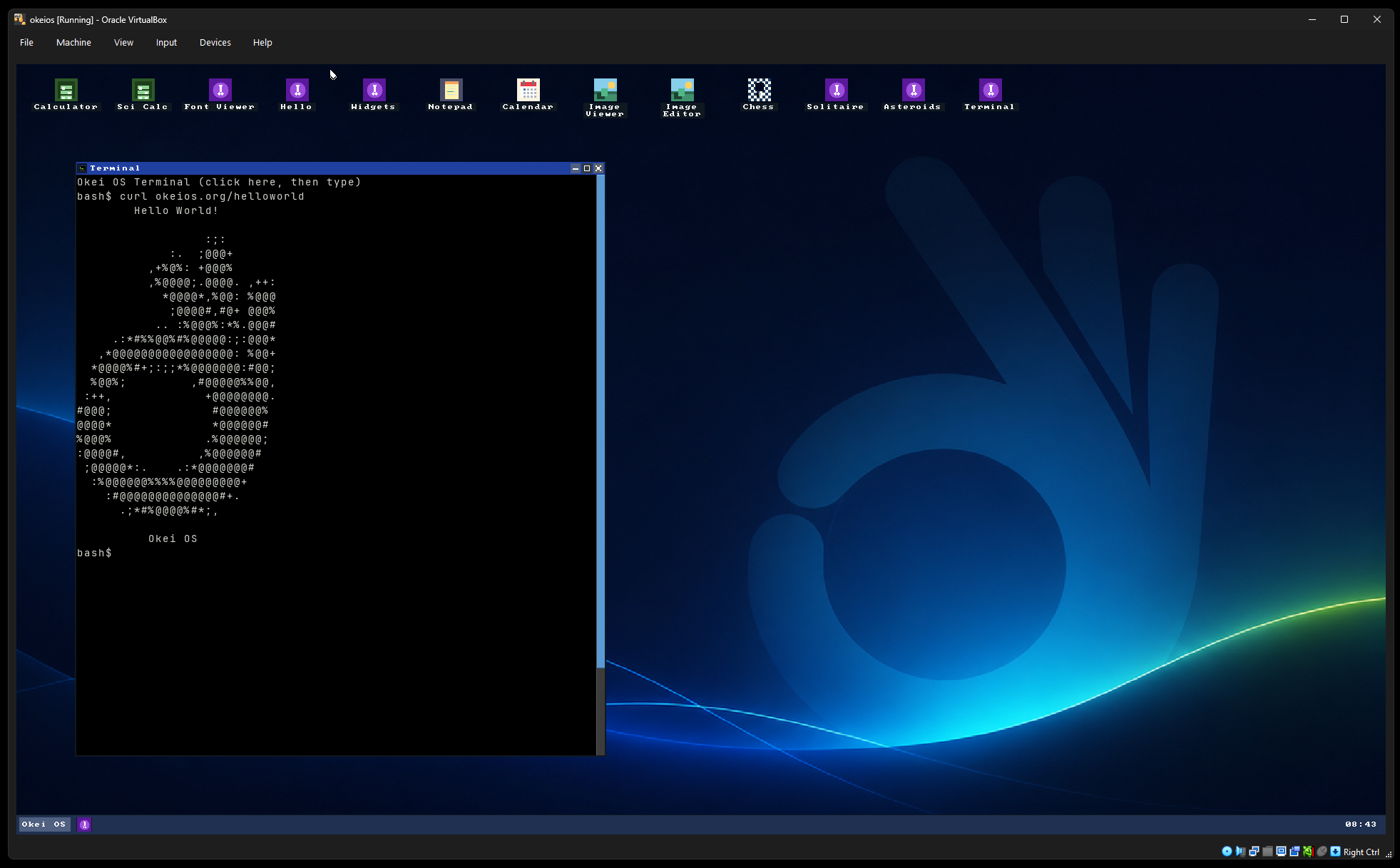
bash$ curl okeios.org/helloworld → Hello World! plus Okei hand ASCII art. Captured 28 Jul 2026.
/bin/curl → public DNS + HTTP GET of okeios.org/helloworldLab work after the 23 Jul public Internet ping closed a deeper slice of the product path:
dbclient → local Dropbear on loopback reaches shell (SSH_SELF_OK) — full TCP connect/KEX/auth, not only ICMP. Residual: graphical Terminal outbound SSH to a remote host.SYS_PTRACE (entry/exit stops, GETREGSET, TRACESYSGOOD) + ported upstream strace 6.9.scripts/marketing_metrics.sh (was 2,885 on 23 Jul; 3,588 on 28 Jul).On 23 July 2026 we captured a live Oracle VirtualBox guest (product profile: VBoxVGA, e1000, ≥512 MiB RAM) reaching interactive bash-5.2# and successfully running ping google.com with an ICMP reply from a public address. That is the product networking claim: not only NAT gateway smokes, but guest-initiated reachability onto the real Internet through the in-kernel stack and userspace tools.
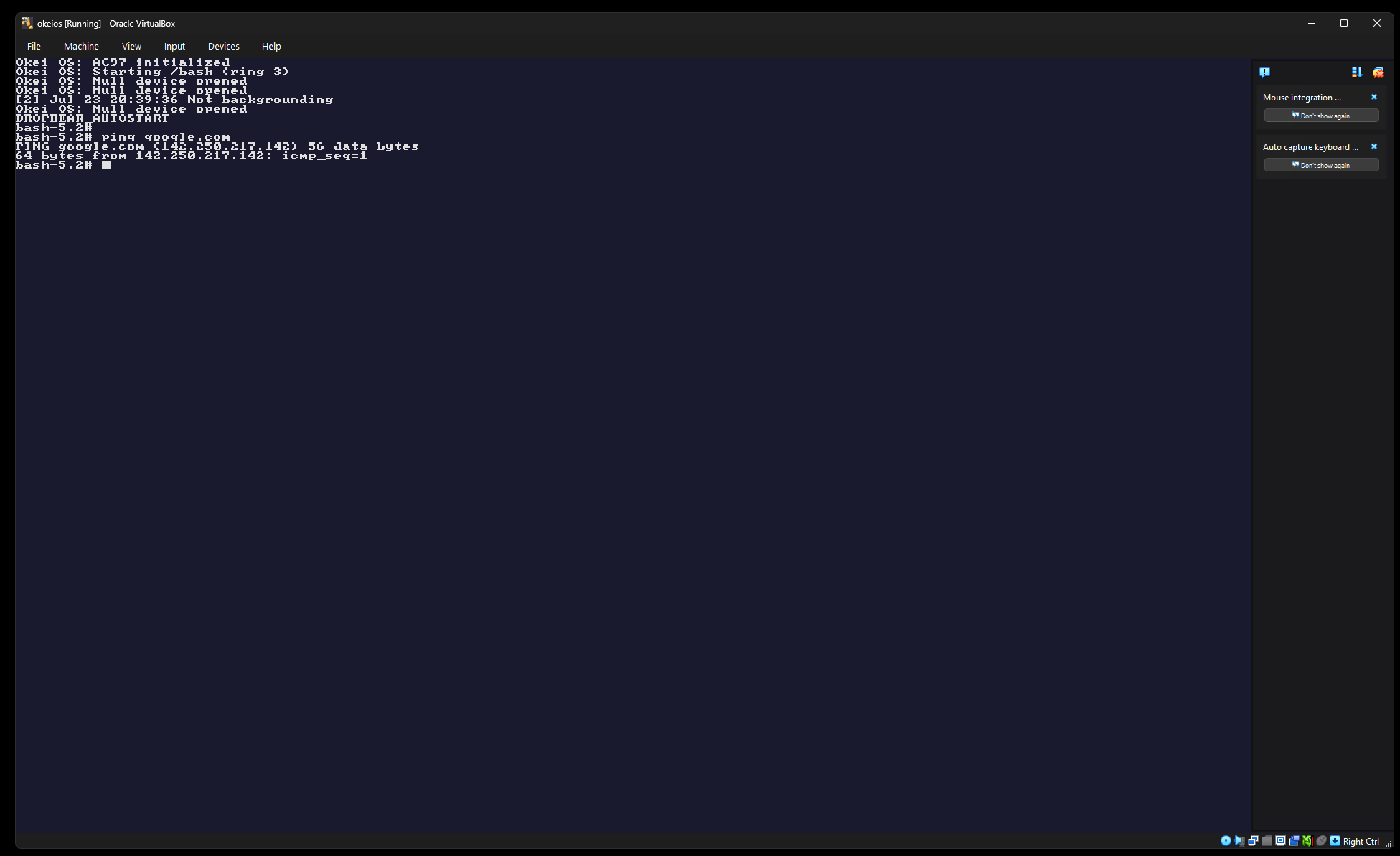
bash-5.2# ping google.com → 64 bytes from 142.250.217.142: icmp_seq=1. Dropbear autostart and AC97 init visible above the prompt.
/bin/bash/bin/pingThe sibling okeios-web project (also still private) is a from-scratch browser emulator for the same guest-visible machine model as our QEMU docs — not v86 (32-bit only), not QEMU compiled to WASM. On 11 July 2026 we successfully ran the real Okei Multiboot2 kernel through paging, scheduler, Ext4 module mount, and execve /bin/bash to an interactive bash-5.2# prompt on the linear VBE console.
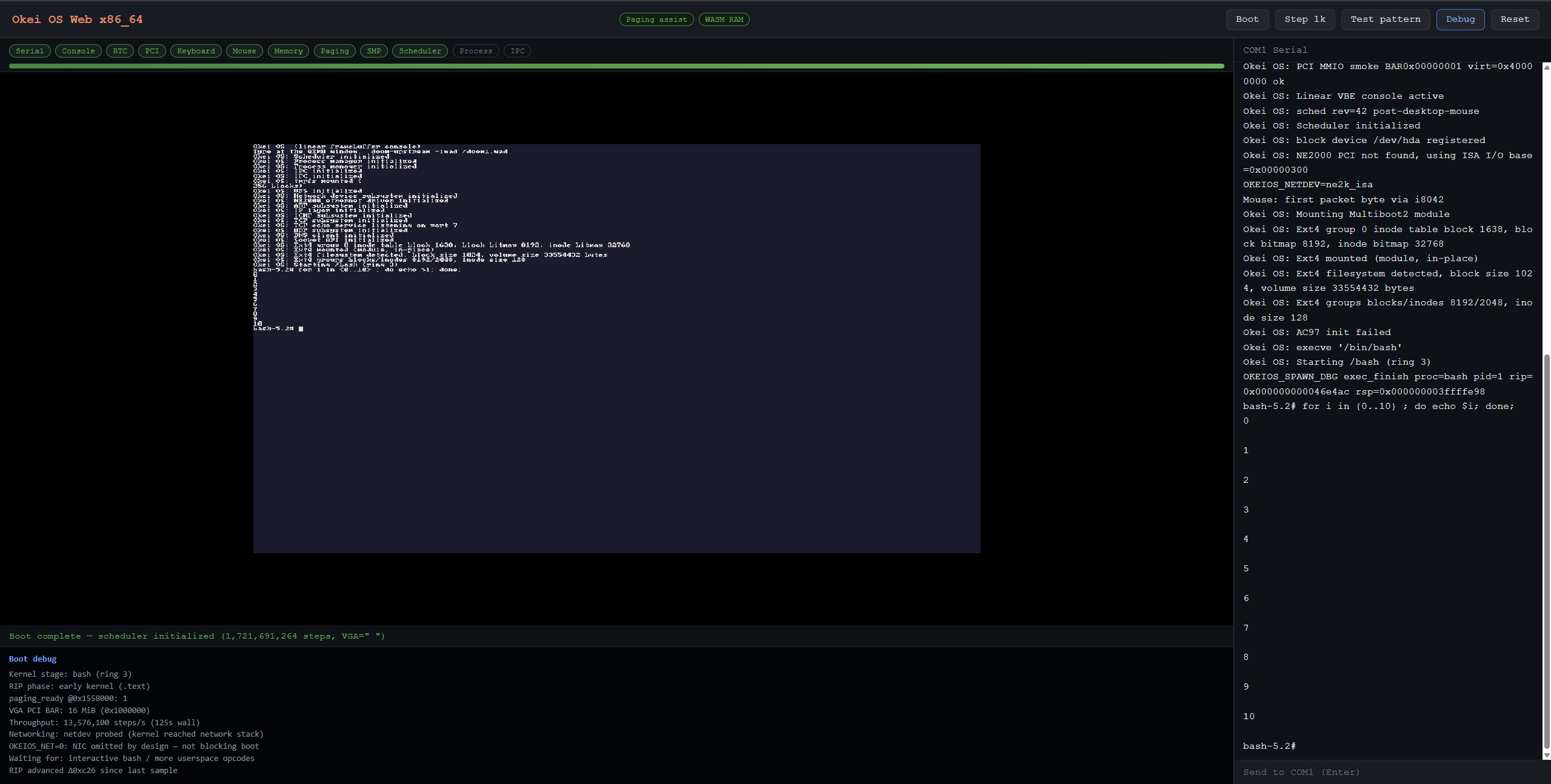
bash-5.2#; serial shows Ext4 in-place mount and shell output for for i in {0..10}; do echo $i; done.
| Area | State |
|---|---|
| ISO / ELF / Multiboot2 load | Done |
| PC devices (UART, VGA, IDE, PS/2, PCI, PIC, PIT, RTC, FW_CFG) | Done |
| Canvas + serial UI + pointer-lock mouse | Done |
| Kernel → memory_init → paging_init | Done (paging assist: seconds to virtual memory) |
| Scheduler, Ext4, VFS, linear VBE console | Done |
| Interactive bash (keyboard, simple commands, brace expand) | Done |
| WASM shared-memory RAM + paging assist | On by default (?wasm=0 / ?pagingAssist=0 to disable) |
| Okei Desktop autostart in web guest | Partial — CLI prompt is the verified default win |
| Full x86_64 interpreter in C/WASM | Next (Phase 2b) — TypeScript CPU is the opcode path today |
smp=1, 1920×1080×32 LFB, ISO + IDE ext4, PS/2, COM1; network disabled; audio stubbedmake iso then in okeios-web pnpm sync-artifacts && pnpm dev (UI title: Okei OS Web x86_64) — not a public serviceentry32.SOkei OS is a monolithic x86_64 kernel — VFS, scheduler, network stack, and drivers run in ring 0. Userspace is static ELF: Bash, Vim, Okei Desktop binaries, coreutils, and diagnostics.
| Layer | What it does |
|---|---|
| Boot | GRUB / Multiboot2 → kernel (~247 KiB); same handoff in QEMU and okeios-web |
| Kernel | Scheduling, memory, syscalls, VFS, TCP/IP, console, framebuffer, PTY, PCI |
| Filesystem | ext4 root image; tmpfs scratch space |
| Network | Custom in-kernel stack — ARP, IP, TCP, UDP, DHCP, DNS, socket API; QEMU TCP client/loopback; VirtualBox NAT/bridged path including public Internet ICMP (23 Jul 2026), host→guest Dropbear SSH, guest self-SSH (26–27 Jul), and userspace HTTP curl okeios.org/helloworld (28 Jul); web MVP leaves NIC off |
| Userspace | Bash primary shell; upstream ports (Bash, Vim, coreutils, curl, Dropbear, strace) over hand-rolled substitutes |
| Desktop | Okei Desktop display server and desktop shell (QEMU-primary; VirtualBox path ~16 s to Terminal in lab; web partial) |
| Install / packaging | MBR/GPT partition-root paths, BIOS/UEFI software gates, hybrid ISO media, safe USB writer, okeios-pkg repo verify, and signed HTTP package fetch smoke |
| AArch64 | QEMU virt path reaches Bash with rootfs, pipes, scripts, stdin inject, and phase-1 GNU coreutils; Pi 5 board hardware gates remain open |
/config/display.conf; guest desktop autostarts on login in our QEMU runsWait/Signal tasks with timer preemption; SMP up to 255 vCPUs (QEMU auto-detect).
4-level AMD64 paging; per-process page tables; physical allocator.
95 handlers: files, processes, mmap, signals, poll, PTY, sockets, IPC mailboxes, ptrace, and filesystem helpers.
ipc_send/ipc_recv with 32 KiB frames powers Okei Desktop clients; capability isolation remains incomplete.
| Area | Status |
|---|---|
| GNU Bash 5.2 | Primary shell; line editing limited |
| GNU coreutils | 75 tools ported and packaged |
| Vim 9.2 | Interactive edit/save smoke verified under the PTY path; still pre-alpha polish |
| Dropbear SSH | Password login, pubkey path, bridged VirtualBox reachability, non-interactive teardown, and guest self-SSH (dbclient→local Dropbear) work in current gates; Terminal outbound to remote host residual |
Userspace ping | VirtualBox guest ping of public Internet host verified 23 Jul 2026 (google.com ICMP reply) |
Userspace curl | curl 8.5.0; VirtualBox desktop curl okeios.org/helloworld (HTTP) verified 28 Jul 2026; HTTPS via mbedTLS in QEMU gates |
| strace / ptrace | Upstream strace 6.9 on SYS_PTRACE (entry/exit, GETREGSET, TRACESYSGOOD) — late Jul 2026 |
| Okei Desktop (22 Start entries) | Registered in apps.conf — Terminal, Notes, Calc, Chess (AI + rules), Solitaire, Asteroids, File Manager, Settings, savers; Login/greeter is not a Start item; some Start execs are not packed on the default ISO; pre-alpha polish |
| Graphics demos | Framebuffer tests and raycaster bring-up |
Okei Desktop is Okei OS’s windowing stack — not X11, not Wayland. A display server owns compositing; applications draw into granted surfaces over IPC. Okei Desktop v1 landed June 2026 for our team (epic closed; our integration tests green) — not a public app store release.
disp-server) — compositor, input routing, window management, 1080p framebufferOkeiOS version 1.0). Headed visual vs prototype still opensw-desktop) — panel with clock, Okei OS Start menu, desktop icons with word-wrapped labels/etc/okeiwin/apps.conf including Terminal, Notes, Chess, Settings, and Theme Manager. Login/greeter was removed from Start (17 Aug)sw-chess-gui) — rules engine, AI opponent, drag-and-drop, check/checkmate, 64×64 Staunton glyphsOKEIWIN_SOLITAIRE_OK, OKEIWIN_ASTEROIDS_OK); Solitaire maximize paint without black voidssettimeofdaywin.sh terminal path, title-bar drag reliability, WM maximize/restore, close repaint/present policy, terminal scroller/resize stability, then-Notepad Open/Exit/F5 fixes (Start name is now Notes), cooperative present scheduling for 60 fps clients, wallpaper/present boot fixes, VirtualBox desktop boot cuts (~16 s to Terminal in lab)make test-toolchain-hello)run_okeiwin_tests.sh and agent debug scriptsLonger-term Aether protocol work targets network-transparent remote surfaces — research only, not shipped. See Horizon.
/bin/bash still static; default dyn product shell still openssh -X x11-req protocol smoke done (Success); headed remote X apps / PRESENT still openMetrics use the same source scope as scripts/marketing_metrics.sh (20 Aug 2026): kernel, boot, userspace, tests, scripts, GRUB, and image config, excluding third-party ports and toolchains. First crossed half a million on 15 Aug (509,590); now 610,468. 4,090 commits since 19 Apr 2026 first SlimOS commit (~33/day over 123 days). Prior: 1,369 / 292k / 2,885 (23 Jul) → … → 3,491 / 509,590 / 5,357 (15 Aug) → 3,857 / 546,816 / 5,825 (17 Aug) → 4,727 / 610,468 / 6,196 now. Syscalls 89 → 102. House-clean 13 Aug–paused 20 Aug (parent still open). Late file growth includes leftover host-unit headers. Rename SlimOS → Okei OS: 21 Jun 2026. Desktop has 22 Start entries (Login removed). Extended facts: llms-full.txt.